
Project Background
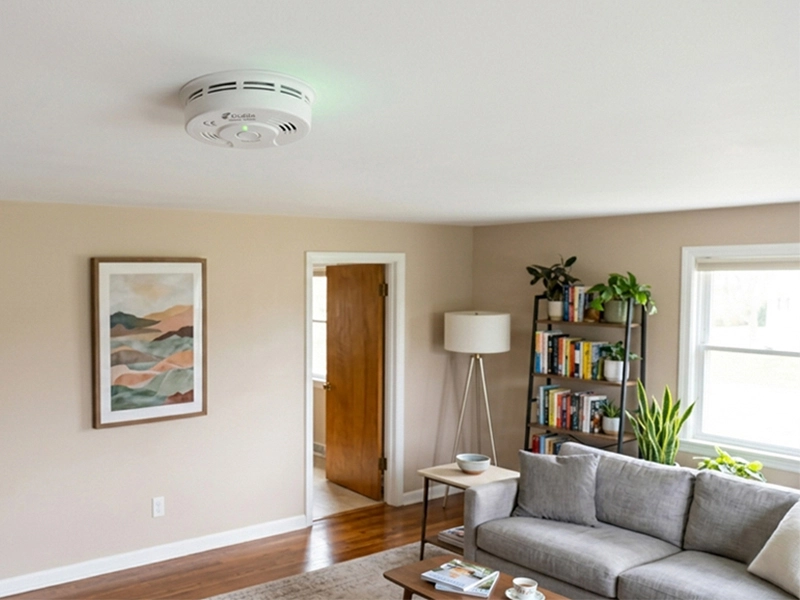
A manufacturer of smart fire safety devices contacted RF Link Antenna during the development of a connected smoke detector platform. The product required stable wireless communication for alarm transmission, remote monitoring, and centralized safety system management.
During early development, the customer tested standard antenna options. However, the results were not consistent when the smoke detector was placed in different real-world installation environments. Signal performance varied depending on the mounting position, building structure, and surrounding materials.
To support the customer’s connected safety device project, RF Link Antenna developed a customized internal antenna solution designed around the actual smoke detector structure and its application environment.
Antenna Challenges in Smoke Detector Applications
Although smoke detectors usually have a simple external appearance, their internal structure can be challenging for RF design.
Inside the device, the antenna must share limited space with the sensing module, main control board, battery or power components, buzzer, housing structure, and other internal parts. This compact layout leaves little room for ideal antenna placement.
At the same time, smoke detectors are installed in many different indoor environments. Some may be mounted on ceilings, others near walls, corridors, stairwells, basements, or enclosed spaces. Materials such as concrete, metal, plasterboard, and insulation layers can all influence wireless signal transmission.
For a fire safety device, communication reliability is especially important. The antenna needs to maintain stable performance after the product is fully assembled and installed in real operating conditions. A general-purpose antenna could not fully meet the customer’s requirements for consistency, structure compatibility, and long-term wireless stability.
Our Custom Internal Antenna Solution
RF Link Antenna designed a custom embedded antenna based on the smoke detector’s internal layout and wireless communication requirements.
Our engineering team evaluated the antenna type, installation position, ground conditions, feed structure, and available internal space. The goal was to achieve a balanced design that could fit the compact terminal structure while maintaining reliable RF performance.
Instead of treating the antenna as a separate component, we handled the project as a complete RF integration process. The antenna was tested and optimized inside the actual smoke detector housing, rather than being evaluated only in an open test environment.
This approach allowed us to better understand how the enclosure, internal components, and installation method affected antenna behavior. Based on these findings, we adjusted the design to improve performance stability after final assembly.
The final antenna solution provided a practical and scalable design for the customer’s connected smoke detector platform. It also gave the customer a stronger foundation for future product development using similar wireless safety terminals.
Project Results
The customized antenna design helped improve wireless stability across different indoor installation scenarios. It also reduced the performance differences that appeared after the smoke detector was fully assembled.
Compared with the earlier standard antenna approach, the optimized solution was better matched to the product structure and real deployment conditions. This gave the customer greater confidence during product validation and helped support the development of a more reliable connected fire safety device.
This project shows why connected smoke detectors often require custom antenna design. For safety-related IoT products, antenna performance cannot depend only on standard specifications. The antenna must be developed according to the terminal structure, housing design, wireless requirements, and actual installation environment.
Why Smoke Detectors Need Custom Antenna Design
Connected smoke detectors are safety-critical devices. Their wireless communication performance may directly affect alarm reporting, remote supervision, and system response.
In real applications, the antenna is influenced by many factors, including the device housing, internal PCB, power components, installation height, ceiling material, wall structure, and surrounding obstacles. These factors can cause signal attenuation, unstable transmission, or inconsistent performance between different sites.
A custom internal antenna helps solve these problems by matching the antenna design to the real product and its application environment. For smoke detectors, fire alarm terminals, and other smart safety devices, this structure-driven design process is often more reliable than simply selecting a standard antenna.
RF Link Antenna provides custom antenna design and manufacturing support for smart fire safety devices, IoT terminals, security products, and connected monitoring systems. From structure evaluation and antenna design to RF tuning, testing, and production delivery, we help customers build antenna solutions that perform reliably in real deployment conditions.